Showing posts with label Kundera. Show all posts

Wednesday, April 29, 2009

Wilde side of DOB

so i currently live in a furnished apt and recently i decided to grab a classic book from the shelf that i'd always wanted to read - The Picture of Dorian Gray, by Oscar Wilde.

i could not have chosen a better book, as i am now finding out. consider these excerpts:
the strange expression that he had noticed in the face of the portrait seemed to linger there, to be more intensified even. The quivering ardent sunlight showed him the lines of cruelty round the mouth as clearly as if he had been looking into a mirror after he had done some dreadful thing.

But the picture? What was he to say of that? It held the secret of his life, and told his story. It had taught him to love his own beauty. Would it teach him to loathe his own soul? Would he ever look at it again?

This portrait would be to him the most magical of mirrors. As it had revealed to him his own body, so it would reveal to him his own soul.

and compare them to these from another book i read recently, Milan Kundera's Unbearable Lightness of Being:
Tereza tried to see herself through her body. That is why, from girlhood on, she would stand before the mirror so often. And because she was afraid her mother would catch her at it, every peek into the mirror had a tinge of secret vice.

It was not vanity that drew her to the mirror; it was amazement at seeing her own "I." She forgot she was looking at the instrument panel of her body mechanisms; she thought she saw her soul shining through the features of her face. She forgot that the nose was merely the nozzle of a hose that took oxygen to the lungs; she saw it as the true expression of her nature.

Staring at herself for long stretches of time, she was occasionally upset at the sight of her mother's features in her face. She would stare all the more doggedly at her image in an attempt to wish them away and keep only what was hers alone. Each time she succeeded was a time of intoxication: her soul would rise to the surface of her body like a crew charging up from the bowels of a ship, spreading out over the deck, waving at the sky and singing in jubilation.

he crew of her soul rushed up to the deck of her body. ... to look in the mirror and beg her soul not to abandon the deck of her body for a moment on this most crucial day of her life.
as humans we are fascinated by the subject of the duality of body and soul. do we recognise ourselves in the mirror? do our bodies represent our soul or do they hide it? i won't go into the problem of defining a dividing line between body and soul (i think that is impossible, more on that when i write about free will) but i think it boils down to a match between our exteriour and our self-image.

now have a look at these excerpts, first from Oscar Wilde. the charactor of Lord Henry says:
It often happens that the real tragedies of life occur in such an inartistic manner that they hurt us by their crude violence, their absolute incoherence, their absurd want of meaning, their entire lack of style. They affect us just as vulgarity affects us. They give us an impression of sheer brute force, and we revolt against that. Sometimes, however, a tragedy that possesses artistic elements of beauty crosses our lives. If these elements of beauty are real, the whole thing simply appeals to our sense of dramatic effect. Suddenly we find that we are no longer the actors, but the spectators of the play. Or rather we are both. We watch ourselves, and the mere wonder of the spectacle enthralls us.
here's what Kundera has to say about this:
Early in the novel that Tereza clutched under her arm when she went to visit Tomas, Anna meets Vronsky in curious circumstances: they are at the railway station when someone is run over by a train. At the end of the novel, Anna throws herself under a train. This symmetrical composition-the same motif appears at the beginning and at the end-may seem quite "novelistic" to you, and I am willing to agree, but only on condition that you refrain from reading such notions as "fictive", "fabricated", and "untrue to life" into the word "novelistic." Because human lives are composed in precisely such a fashion.


Beethoven bust at Walhalla
They are composed like music. Guided by his sense of beauty, an individual transforms a fortuitous occurrence (Beethoven's music, death under a train) into a motif, which then assumes a permanent place in the composition of the individual's life. Anna could have chosen another way to take her life. But the motif of death and the railway station, unforgettably bound to the birth of love, enticed her in her hour of despair with its dark beauty. Without realizing it, the individual composes his life according to the laws of beauty even in times of greatest distress.

It is wrong, then, to chide the novel for being fascinated by mysterious coincidences (like the meeting of Anna, Vronsky, the railway station, and death or the meeting of Beethoven, Tomas, Tereza, and the cognac), but it is right to chide man for being blind to such coincidences in his daily life. For he thereby deprives his life of a dimension of beauty.
it seems Kundera found reading Wilde rather stimulating, and so do i. recommended reading for students of the human condition.

Sunday, March 22, 2009

but is it? is it art?

i have had many discussions about this question, and none of them were boring. are there any criteria for art to be enjoyable or is it a feeling that just happens? i'll try to answer it from my perspective so that hopefully i'll hear of yours - i'm curious!


DOB original blue
so when does art speak to me? let me use the example of some well-known pieces. it makes for familiar ground and more colourful reading. i will use modern art because only in the 20th century was the artist liberated from the traditional task of depicting that which can be seen, to finally focus on that which cannot.
so i'm at this art gallery for a particular exhibition. there is a lot to see, a recurring theme seems to be this cutesy cartoon character. i don't think much of it, walk on.


Melting DOB E
somewhat later, i encounter its reincarnations, with grinning grills and sharp fangs, interestingly warped. a contrast of sorts. cute and dangerous, one and many, standard and weird, good and evil. that's probably it. a very familiar theme, nothing to see here, move right along.

Tan Tan Bo
Italian max
further on, with me barely noticing, different colours appear, wholly different colour schemes. ok, an extension of the simple idea of contrasts. the negative colour palette is slightly unnerving. standing a portrait on its head can make a smiling face look like it's frowning. a colour negative to me looks ... wrong.

then, a vast multipanelled, twistedly gorgeous painting. no cuteness, no straight-up good vs. evil. a comparatively tiny speech bubble at the center left, whose translation i sadly haven't found on the web so far, helps to understand what it is meant to say.
it's the discomfortingly fascinating unadulterated despair of the bile spewing, moribund DOB that doesn't seem to sit well with the cartoon character. and here it is, the clash of ideas, the juxtaposition of perspectives, the strangeness that makes me ponder a work of art even when i have long left the building.


Tan Tan Bo Puking aka Gero Tan

i can't exclude the possibility that, as i was viewing the exhibition chronologically, the earlier pieces (that i hadn't paid attention to) prepared me for the appreciation of art i experienced at the last one. the end result though, no matter if it concerns the last piece or the entire exhibition, is for me that i felt because i was interested. feeling art to me is linked to motivation, the challenge to grasp its content. the accompanying superflat style of the pieces adds to the content but, by itself, doesn't interest me. it is a technique of simplification that lets the unseen shine more brightly. it may make something look pretty but it is not beautiful. for me, beauty in the post-19th century sense emerges from the inside of an artwork.


Orange Eater
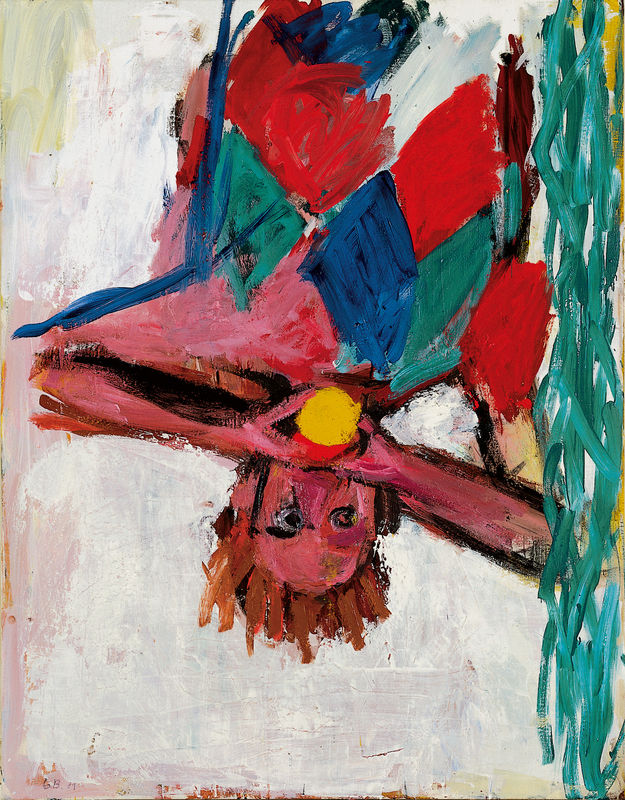
since the topic of this post is paintings, it is tempting to keep literally illustrating this notion. :) the munich museum of modern art has a room full with works of Baselitz, who, for some reason, at one point decided to paint upside down. one recurring subject is the orange eater, left. i haven't found anything online in terms of why he is interested in this subject, save for the usual babble along the lines of "the intense colour jumps out at the viewer" (read, i have no idea what i am talking about). so if you know why he paints those, let me know. i want to talk about another piece though.


Eagle, Remixed
masdearte.com
the eagle, by the same artist, is also a revisited subject. knowing that the artist paints upside down we can recognise that this eagle is soaring or landing. what intrigues me is that we can choose to ignore that knowledge and let the same eagle plummet, trundle downward, helplessly. that way we can conjure up a dualism that would be difficult to attain if the painting hung the other way round. add to this the fact that the eagle is a national symbol of germany and can be found displayed prominently in german parliament and in the german coat of arms and you may understand why i mention this piece. at one point it hung in the office of the then german chancellor Schröder. i wonder what his reasons were and if he thought the same way about it.


American McGee's Alice
how about computer games? people like them, they are commercially successful. is there art in them? i don't have time to play these days but i can remember back when i did, on occasion i was put in awe. one such example is American McGee's Alice. the premise is that Alice is in a mental institution due to losing her parents at a young age and we are playing for her sanity, inside her mind.

i think the game does a great job of depicting that which we cannot see. something is tangibly wrong, door frames are all skewed, we walk into empty rooms that are suddenly full of strange creatures, objects fly around, and, every so often, the floor literally drops out from beneath our feet. we jump between ice floes of sanity that unrelyably keep us afloat over the cold sea of nothingness. this unnerving scenery evolves as the story unfolds. yes, i think there is art to be found here. still images, however, don't do it justice, it has to be played. a video capture of someone else's gameplay is the next best thing.


American McGee's Alice captured gameplay. mute the comment if you want

so i'm not a purist, i find art in many things. what, then, isn't art for me? i can think of a few issues with some pieces purporting to be art. the act of taking an everyday object, giving it a title and placing it out of context, in a gallery, doesn't make it art for me. i'm not saying that there needs to be skill in creating art. what i mean is that the mere act of provocation is not enough. it's too easy.
in the same way, stating the obvious, too, doesn't do it for me. if there is just one clever idea expressed in an obvious way i think, hm, neat, and walk on. if that single idea is used again and again it gets on my nerves. piling on clever ideas doesn't help. two ideas, even if they are different, disjointly united in one piece with no relation between them other than trying to impress the audience, might as well be hanging at different ends of the gallery.

one subject, one issue, one clever idea is not enough. there need to be at least two, and they need to interact, intersect, compete. which brings me back to Kundera's Unbearable Lightness of Being. in it, the character Sabina is an artist rebelling against socialist realism by having the true nature of the objects of her art break through the surface.
Sabina's paintings, past and present, did indeed treat the same idea, that they all featured the confluence of two themes, two worlds, that they were all double exposures ... On the surface, an intelligible lie; underneath, the unintelligible truth ... A landscape showing an old-fashioned table lamp shining through it. An idyllic still life of apples, nuts, and a tiny, candle-lit Christmas tree showing a hand ripping through the canvas.
i read this only recently and found my own idea of what i appreciate in art confirmed. it's good to be reassured.

ps: hunting down pictures for this post has been fun. through google image search, i found quite a few interesting pages discussing art. here's one, If you could own one peice of art (sic). googling "if you could own one piece of art" brings up a whole bunch more to look at. enjoy. and if you want, tell me your favourite!

Saturday, March 21, 2009

why?


so i started a blog.
not the most bleeding edge thing to do, i know.
no, i don't want to join twitter.

but why???


as Kundera wrote, we all choose motifs for the symphony of our lives. so do i. these are certain things that are important to me, i get intense about them and dig deeper.


it's only fool's gold
occasionally a news item just needs a comment, and for that, there are comment forums and letters to the editor. but those are mere blips in a flood of posts and emails and, let's face it, usually unread and therefore inconsequential. and who can blame those who skip over all previous comments and just post their own? after all, we each are the most important characters in our own life story. private emails and social network posts are slightly better, they are at least read by the person they are addressed to.

but how do i make an impact? on more than one person? maybe i can persuade a few people to come here and read this. instead of losing my thoughts in a sea of opinion, perhaps i can convince a small number of you to care and read several of my posts because you liked one. in short, a blog.

i will try to produce output, type fast and not worry about capital letters. :)

i will try my best to produce something substantial that is worth reading. after all, it's so hard to find a grain of gold in the desert.